Making the business case for climate action: introducing Navigate
The challenge
How do you make a compelling business case for climate action when budgets and resources are under pressure and every investment has to earn its place?
We’ve heard this question more and more from sustainability leaders this year. Even when leadership cares about climate, there isn’t a clear enough impact on the business to give it precedence.
Instead, climate interventions risk getting stuck in a box marked "philanthropy": nice to do, good for the planet and for employee morale, but not connected tightly enough to the core business to release meaningful budgets. Compared with risk management, resilience or revenue growth, climate action in 2026 often falls to the bottom of the priority list.
The solution
What if we could automatically map your company data to identify your key business priorities, then find the climate interventions that could make a meaningful contribution to achieving them?
What if we could turn that analysis into a CFO-ready business plan that quantifies the impact both on the business and the climate, and sets out all the resources needed to deliver?
And what if we could structure financing for the plan, arrange its execution and report back on its progress over time, all the way through to completion?
Enter Navigate
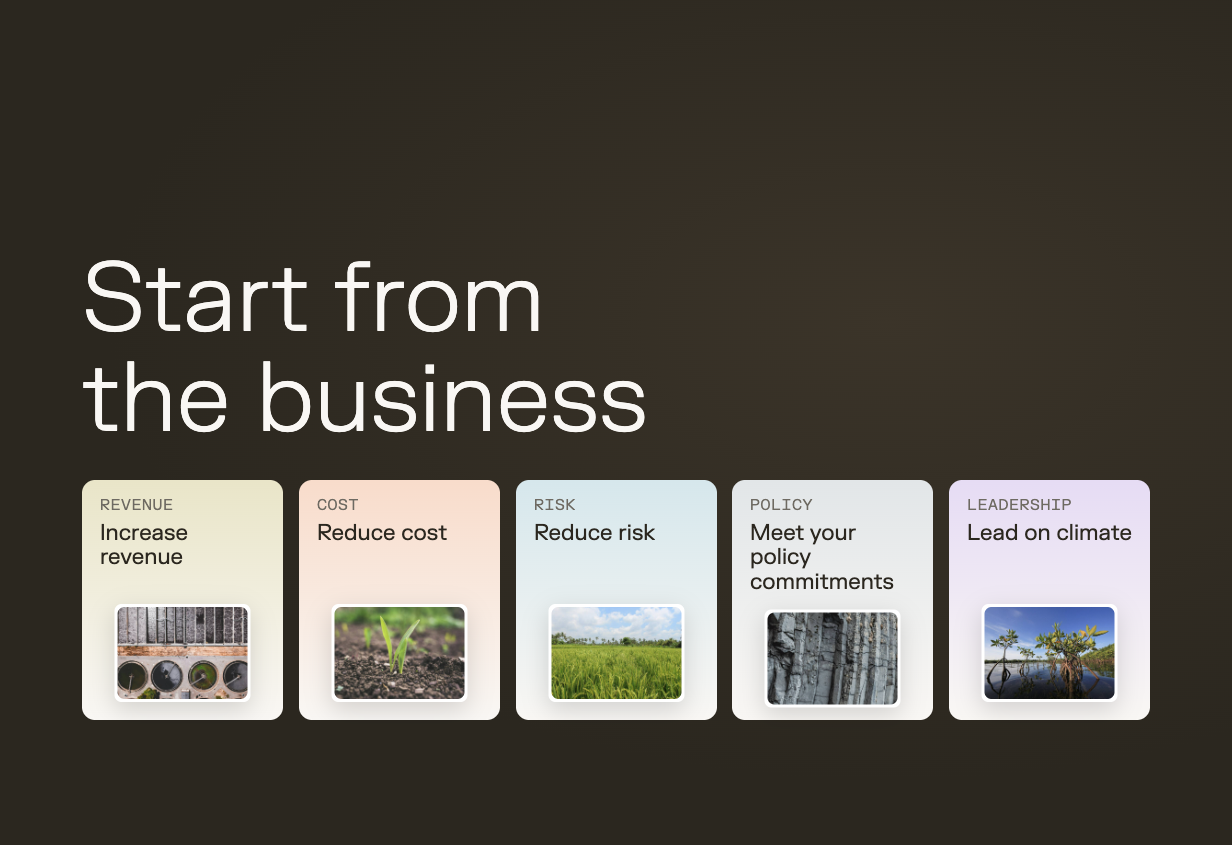
As CUR8 approaches its fourth birthday, we are excited to launch a product that combines all of our experience, expertise, proprietary data and advancements in AI to achieve exactly that. Navigate automatically researches business priorities and identifies projects that can help deliver them. Climate interventions have a remarkable range of benefits beyond their carbon impact, from improving water security, health and agricultural productivity to strengthening communities and creating new commercial opportunities. Navigate analyses these attributes and identifies the interventions and individual projects with the strongest potential to contribute to the company’s priorities, whether by growing revenue, reducing costs, managing risk, strengthening supply chain resilience or maintaining a licence to operate.
Steered by CUR8’s expert team, it then builds an evidence-based business case. CUR8 can help structure the financing, arrange implementation and track outcomes over time. The whole process takes just a few meetings with a client, and at a fraction of the cost of a bespoke consulting arrangement.
We have two aims: First, to identify the business value that unlocks new investment in climate action. Second, to enable better decisions, showing which investments are integral to what the business is already trying to achieve, and which simply don't stack up.
A business case that stands up to scrutiny
A compelling business case has to answer more than one question. How will this investment contribute to our business priorities? What benefits can we expect, and how confidently can we measure them? What are our competitors doing? What do emerging policies and standards mean for us? And what will it cost if we wait?
Navigate brings these strands together. Where benefits can be quantified, we use the best available evidence to do so. Where they cannot, we make the strategic rationale clear without pretending that every benefit can be reduced to a financial return. The result is a business case that speaks the language of finance without losing sight of the climate outcomes that motivated the investment in the first place.
Human first, AI powered
Navigate is both a software and a service. The software does the heavy data work; CUR8's experts shape the recommendations and build the case alongside your team. In practice, it works like this:
- We start without asking you for anything. Navigate builds a sourced profile of your company on more than 50 indicators from public evidence: business and operations, footprint and value chain, climate baseline, strategy and commitments, track record, and wider company context. We build a detailed digital profile of your company and its supply chain. Every fact carries a label, so you can see what we know and how we know it.
- You confirm the profile and rank your priorities. This is where your team adds what isn't public, such as sourcing volumes, regions, suppliers and spend. Share the data with our team or enter it directly into the tool. We will never train our models on your confidential data.
- We match interventions and projects to those priorities, drawing on PRISM, CUR8’s proprietary data model which holds detailed information on more than 1,000 climate projects in over 90 countries. Navigate identifies the interventions with the strongest ROI. You challenge the recommendations, we revise them.
- You receive a business case built to secure a budget: a recommended portfolio, the rationale for each choice, the expected business outcomes and the evidence behind them, the trade-offs on cost, scientific quality and delivery risk, the competitor and policy context, and the cost of waiting or inaction.
- From start to finish in 3-5 meetings: the first draft is designed to be 60% accurate and show the art of the possible. Together, we refine the priorities, complete the data where it’s needed and improve the draft until it’s ready for your exec team.
- Strategy to financing, execution and reporting: unlike most consultants, we don’t stop at strategy. Once you're ready to act, CUR8 can arrange execution with the most trusted project developers, structure the financing needed and provide regular reporting on the progress. You no longer need to request extra team resources to deliver a new project.
The main advantage
The main advantage of this approach is changing where the time and effort go. Instead of humans having to spend weeks gathering company information, researching projects and searching for connections between them, Navigate does much of that work automatically. This frees CUR8’s experts to concentrate on what matters most: assessing the evidence, challenging assumptions and identifying the investments that genuinely make sense for your business.
CUR8 has built years of scientific and market expertise in assessing climate projects and working with developers and corporate buyers, and has deep knowledge of carbon markets and the evolving policy and standards landscape. That expertise, backed by a science team led by Dr Gabrielle Walker, provides the foundation for Navigate’s recommendations.
In other words, the scientific models and judgements come from human experts, while AI lets us apply them at a scale and speed that people alone could not achieve economically. It’s this combination of automated analysis and expert judgement that makes tailored business cases economically viable even for relatively modest investments.
What this looks like in practice
The opportunities Navigate identifies can look very different depending on the business. Here are three illustrative examples, showing how we connect business priorities with climate interventions, assess the potential financial benefits and identify what still needs to be tested before investing. They represent just a small part of the much wider range of climate interventions and business priorities Navigate can explore.
Protecting your access to water
A semiconductor manufacturer runs plants in a water-stressed region of Asia. Irrigated rice is the biggest water user in the same river basin. Navigate identified a methane reduction project in nearby rice paddies using alternate wetting and drying. Letting fields dry out between irrigations instead of keeping them flooded can cut water use by up to 30% and methane emissions by around half, without reducing yields when drydowns are timed well.
The opportunity connects water security, relationships with local farming communities and climate impact in the basin the company depends on. Navigate can assess the benefits of reducing the risk that drought halts production, as well as how much of the water savings would count toward the company’s watershed replenishment targets. It also calculates how farmers would be paid to adopt the practice, and what monitoring is needed before the company commits. Water benefits are measured under WRI’s Volumetric Water Benefit Accounting framework and only count if the project is in the same basin as the plant. Selling the methane credits to a separate buyer can bring down the cost, as long as combined payments do not exceed what farmers need to make the change and each outcome is claimed by only one buyer.
Increasing your energy resilience
A financial services company was seeking to improve the resilience of a data centre. Navigate suggested co-locating it with a biochar plant that processed local waste. It explored how surplus heat from the plant could generate electricity and provide cooling, while also producing carbon removals.
The opportunity combines energy resilience with climate benefits, but depends on engineering feasibility, commercial arrangements and backup power. Navigate can assess different ownership and contracting structures and identify what needs validating before the company commits.
Turning waste into cash
A European food manufacturer produces around 13,000 tonnes of shells and husks annually, pays to dispose of them and uses gas for processing heat. Navigate identified an opportunity to convert those residues into biochar, generating useful heat, avoiding disposal costs and creating revenue from both fertilizer and carbon removal credits.
Initial modelling suggested a €9 million investment could generate approximately €2.1 million annually after operating costs, with a payback of around four years. The business case distinguishes established evidence from assumptions requiring validation, particularly equipment costs and how much of the heat the factory could actually use.
From business case to climate action
Once the budget is secured, the next step is to put it to work. We know that even with the budget in place, the next constraint is team time and resources - which is why you can outsource most of the heavy lifting to us. CUR8 already helps companies source and assess projects, and structure and manage purchases. We are developing Navigate to bring more of that journey together, including insetting, financing, programme management and measuring outcomes.
The implications go beyond individual companies. By identifying climate interventions that contribute directly to a company's business priorities, and making it affordable to build a credible case for them, Navigate can unlock budgets that would otherwise stay out of reach. Climate solutions can't scale on the commitments of a handful of very large buyers. Individually, these investments may be modest. Together, they could provide the demand that climate solutions need to scale.
Whether that demand arrives depends less on the science than on whether the case can be made in the language the rest of the business uses. That is the problem Navigate was built to solve.
If you'd like to see what Navigate can find for your business, book a demo.

November 2, 2026