Carbon at Risk: Why the cheapest carbon credits aren’t always the best value
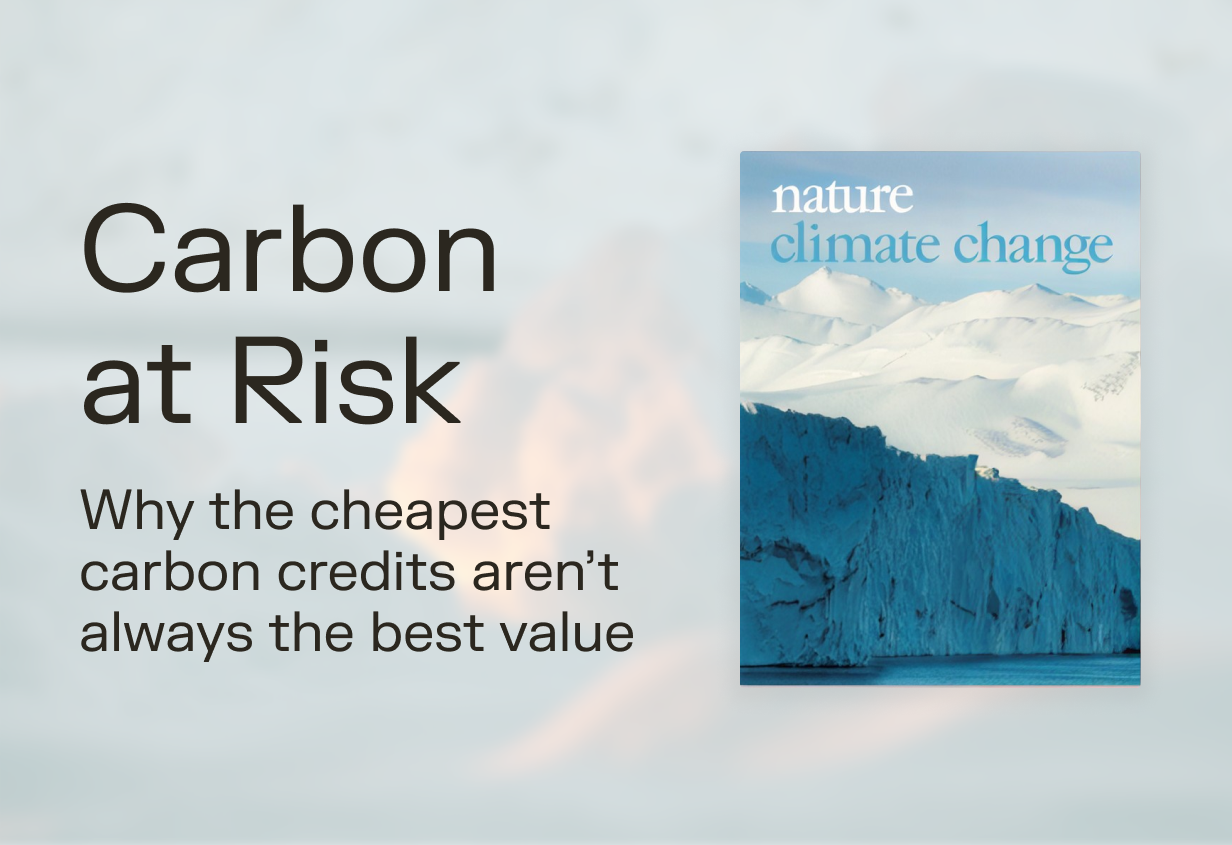
How do you know what carbon removal to buy? Different types come with wildly different costs, benefits and risks, so how do you work out which ones to invest in, and how much of each you need? That’s the question tackled by a new paper in Nature Climate Change, which I’m delighted to have co-authored.
The paper, Carbon at Risk, grew out of discussions we started back in 2023 at Rethinking Removals, CUR8’s sister organisation, about how to get beyond the unhelpful divide between nature-based and technological removals. Rather than arguing about which is better, we wanted to understand how to combine different approaches, with their different costs, benefits and levels of durability, to get the best results.
One of the things I particularly like about this work is that we’ve borrowed an idea from the financial world. Value at Risk is a well-established tool for measuring how much money an investment portfolio could lose over a given period, at a given level of confidence. Carbon at Risk applies the same thinking to carbon removal: how much of the carbon you’ve paid to remove might end up back in the atmosphere, and how confident can you be that it will stay stored? It gives us a common yardstick for comparing very different kinds of carbon removal, and for working out how to manage the risks.
This matters because the carbon removal market needs to attract a great deal more investment, and companies need to know they’re getting value for money. That’s the challenge we’re tackling at CUR8 with Navigate, our new platform for helping companies build the business case for climate interventions, taking account of their wider benefits for the business as well as their climate impact.
A crucial part of that is knowing not just what an intervention costs, but how reliably it delivers the climate outcome you’re paying for. Carbon at Risk gives buyers a way to quantify the risk that the carbon they’ve paid to remove will end up back in the atmosphere, and to work out whether a different mix of removals could deliver the same climate outcome for less money. Because the cheapest carbon credit isn’t necessarily the best value.
The results are fascinating. The paper shows why simply buying more trees isn’t necessarily enough to ensure that carbon stays stored. Forests are vulnerable to fire, disease and a changing climate, and crucially, those risks are often shared. If a major fire or changing climate conditions affect many projects at once, buying more forest credits won’t necessarily provide the protection you need.
That’s where higher-durability removals come in. Using a model that combines forest carbon with direct air capture and geological storage, the paper shows that adding higher-durability removals can be a more cost-effective way to manage these risks than relying on forests alone. None of this means we should stop investing in forests. What we need is to understand how much of each type of removal we need, taking account of their different costs, durability and exposure to shared risks. And Carbon at Risk gives us a way to start putting numbers on that.
I’m enormously proud of what this team has achieved, from the first conversations at Rethinking Removals to a paper in Nature Climate Change. Huge congratulations to Bali Lee, Tom Bearpark, Ben Groom and all our co-authors, and thanks to everyone who contributed along the way.
For me, the exciting next step is putting this into practice. We’re now bringing Carbon at Risk into Navigate, so that companies can use it to make real purchasing decisions, not just understand the risks in theory. If we can help buyers put a number on the durability they’re getting for their money, we can start to change where investment flows — towards portfolios that deliver more reliable carbon removal, rather than simply the cheapest credits. That’s when this research will really make a difference.
Read the paper: The Carbon at Risk measure for managing carbon removal risk and guiding portfolio construction — Nature Climate Change

November 12, 2026