SBTi and ISO: What the New Net Zero Standards Mean for Carbon Removals
Net zero standards are like buses. You wait for ages and then two come along at once. In the past few weeks we’ve had the publication of the SBTi Corporate Net-Zero Standard V2.0 and the draft ISO 14060 Net Zero Aligned Organizations standard, and both have dramatic implications for how corporates should be thinking about carbon removals.
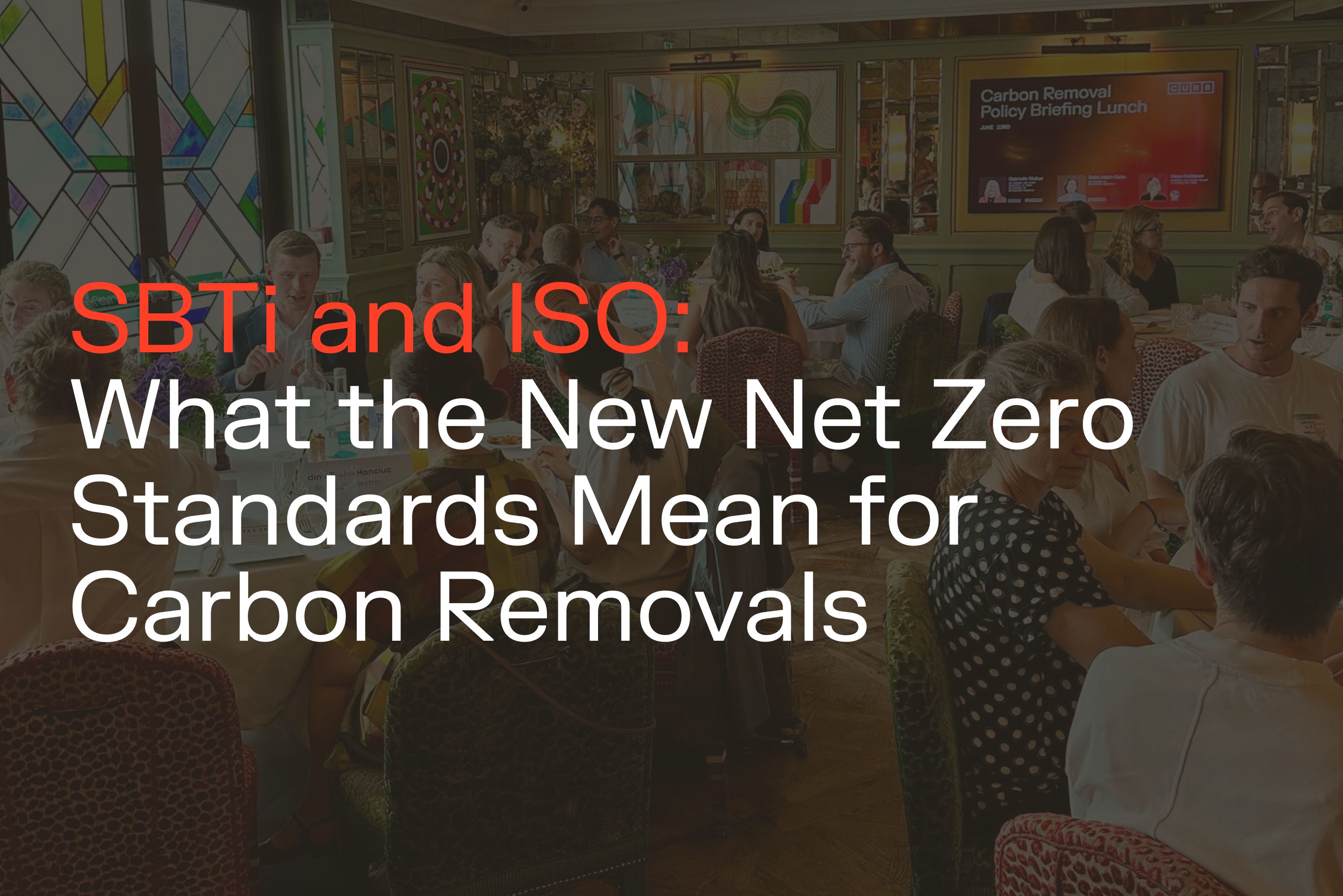
During London Climate Action Week, CUR8 and our sister NGO, Rethinking Removals, brought together around 40 companies, together with several of the people involved in writing these standards, to discuss exactly how the new standards are upending our thinking on rules around removals.
Short-term targets
The biggest headline is about when to act. For years, carbon removals have occupied a strange, orphan place in corporate climate strategies. Everyone agreed we’d need them eventually, but nobody had a particular reason to start now. The science tells us we need removals at the gigatonne scale by 2050, and standards typically fixated on that date without thinking about what needs to happen to build the industry in the meantime. They effectively said: “you’ll need removals in 2050, so start thinking about them in 2049 and a half.” Now, in both new standards, that has changed.
Take SBTi. For the first time, a major corporate net zero standard has set a short-term target for carbon removals. From 2035, Category A companies — broadly, larger companies and medium-sized companies headquartered in high-income countries — will be required to use carbon removals for a share of their ongoing emissions, starting at 1% and rising over time. I admit I wished it had gone further; many of us argued directly to SBTi leadership that the requirement should start earlier. But this is a world first, and deserves to be celebrated.
ISO also requires corporates to set an interim target for removals as a key part of their net zero plan, and theirs is sooner still — the first milestone falls within five years of setting targets. I think it’s interesting that, for carbon removals at least, ISO is both more ambitious and more pragmatic than SBTi. More ambitious because it expects companies to start planning immediately. More pragmatic because, rather than prescribing exactly how every company should do this, it provides principles and examples and lets organisations work out what makes sense for their own business.
That answers the question of when. The rest of our discussion was about how.
Different approaches
One interesting difference is where the two standards begin. SBTi builds forwards from the present, focused on companies taking responsibility for their ongoing emissions, starting now. ISO builds backwards from the end state, starting with the residual emissions a company is likely to have left once deep decarbonisation is done, and working back from there. Both land on a short-term removals target — they just get there from opposite directions.
The standards also take different approaches to durability. SBTi adopts a matching principle: long-lived greenhouse gases should ultimately be balanced with long-lived removals, while shorter-lived gases may be balanced with shorter-lived removals. ISO takes a simpler approach, requiring removals used towards net zero to have a minimum durability of 100 years. The practical implications of those approaches will no doubt be debated, but they’re both a significant step forward from simply talking about “removals” as though they’re all the same.
What the standards have in common
For me, the similarities between the standards were at least as interesting as the differences. Both reject the idea that there is a single right way to incorporate removals into a corporate strategy.
SBTi does this through an implementation hierarchy, recognising that companies may start in different places depending on where removals make most sense for their business. ISO comes at the same idea through a spheres of influence approach — asking companies to think about where they can have influence through their operations, supply chains, products, customers, investments or wider partnerships.
The language is different, but the underlying philosophy is remarkably similar. Don’t ask what removals to buy, start by asking where removals make sense in your business.
The same is true when it comes to action beyond a company’s own emissions. SBTi creates an optional but strongly recognised pathway for companies that want to go beyond the minimum requirements before 2035. ISO makes this part of what it means to be a net zero aligned organisation. Companies are expected not only to reduce their own emissions but also to demonstrate how they are contributing to global net zero through their wider spheres of influence. In both cases, carbon removals have an important role to play. It’s not a requirement for removals, but it is permission.
Removals for shortfalls
One aspect of the new SBTi standard that many people seem to have missed could prove extremely important. SBTi explicitly encourages companies that fall short of their emissions reduction targets, despite best efforts, to use removals to address the shortfall. That doesn’t allow a company to claim it met the target, but it is a way to demonstrate that you are taking the target seriously.
An open door on ISO
One final practical point: unlike SBTi, ISO is still in draft. Companies can submit feedback through their National Standards Body, ideally backed by practical implementation experience — most national consultations close in mid-August, ahead of a 9 September deadline for country submissions. Those real-world examples are exactly what will help standards writers distinguish genuine barriers from perceived ones and produce a stronger final standard. If your team has been testing removals procurement, durability approaches or insurance mechanisms, this is the moment that experience is worth the most.
The takeaway
My biggest takeaway from the lunch wasn’t that SBTi is better than ISO, or vice versa. They are just different. SBTi is a practical implementation and recognition framework. ISO is a broader international consensus standard that is likely to shape regulation, procurement and policy. And it’s impressive that even though they use different mechanisms, they are pointing in the same direction.
Carbon removals are no longer just something you buy at the end of the journey to balance residual emissions. They’re becoming an integral part of transition planning, business strategy and climate action now. For companies wondering what to do next, the biggest no-regrets action is to stop thinking about carbon removals as something for later, and start working out where they fit in your business today.

July 9, 2026

.jpg)
.png)