A Fireside Chat With Microsoft's CSO and CUR8 at Goals House in Davos
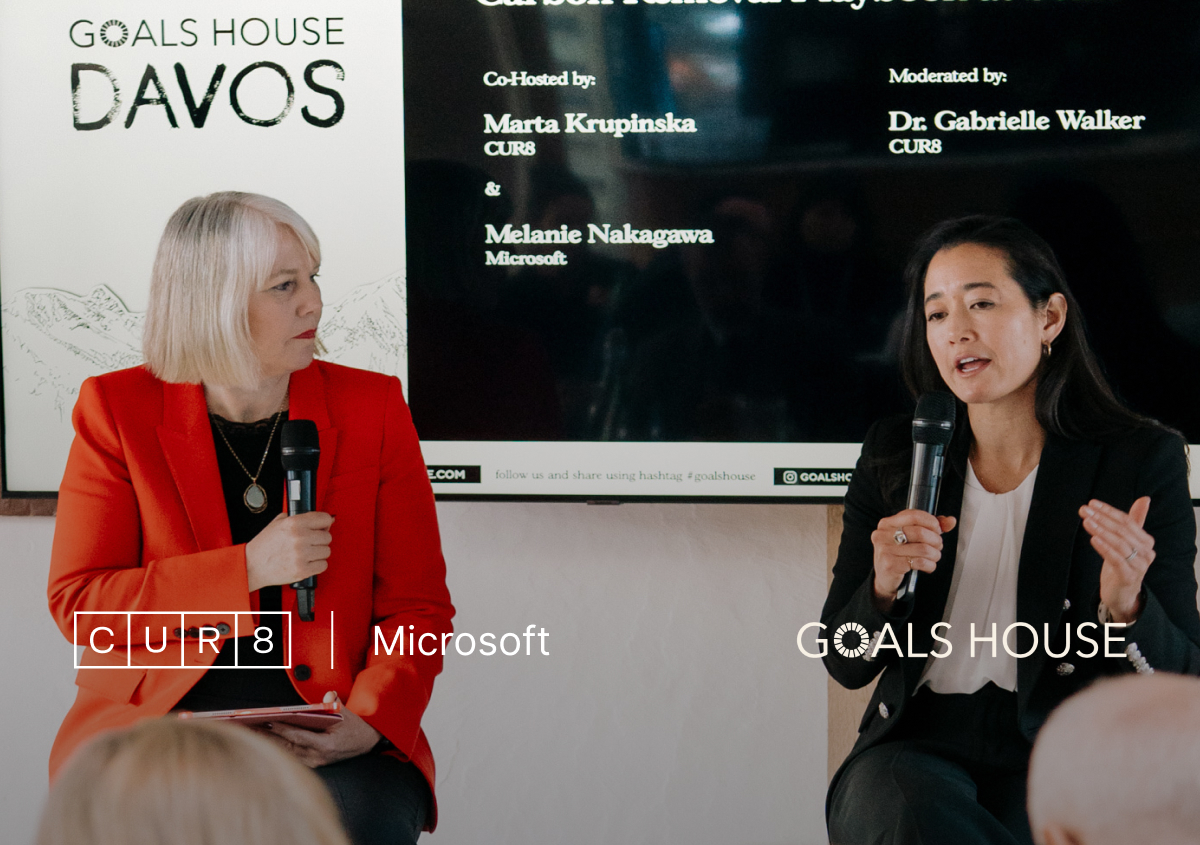
At Goals House Davos 2026, CUR8 Chief Scientist and Co-Founder Dr. Gabrielle Walker sat down with Microsoft's Chief Sustainability Officer Melanie Nakagawa for one of the most candid conversations you'll hear about what it actually takes to build a corporate carbon removal programme — and what everyone else can learn from it.
The session, "Pilots to Portfolios: Deploying a Carbon Removal Playbook at Scale," was followed by a roundtable with senior leaders from British Airways, Standard Chartered, and Deloitte.
Watch the full conversation below, and read on for the key themes.
Why Now?
CUR8 consistently hears the same question from companies: I know removals are important, but why do I need to act now? Melanie's answer built from a simple premise: Microsoft needs a removal market to exist by 2030, and that market won't exist unless someone helps build it now. Being a first mover isn't altruism — it's the only way to ensure the supply you need will be there when you need it. And alongside that, buying now is how you show the market you have a credible path to your targets, not just a promise. Companies that have flip-flopped on their sustainability commitments haven't been rewarded for it, and a target without visible homework behind it is starting to look the same way.
Gabrielle pointed out that the policy signals are tightening too. The UK is integrating removals into its ETS by 2029, the EU is following in the early 2030s, and both the SBTi and ISO net-zero aligned organisation standard are expected to require interim removal targets this year. Rather than a just a voluntary market, this is starting to look like “pre-compliance”.
Nature vs. Engineered: The Wrong Question
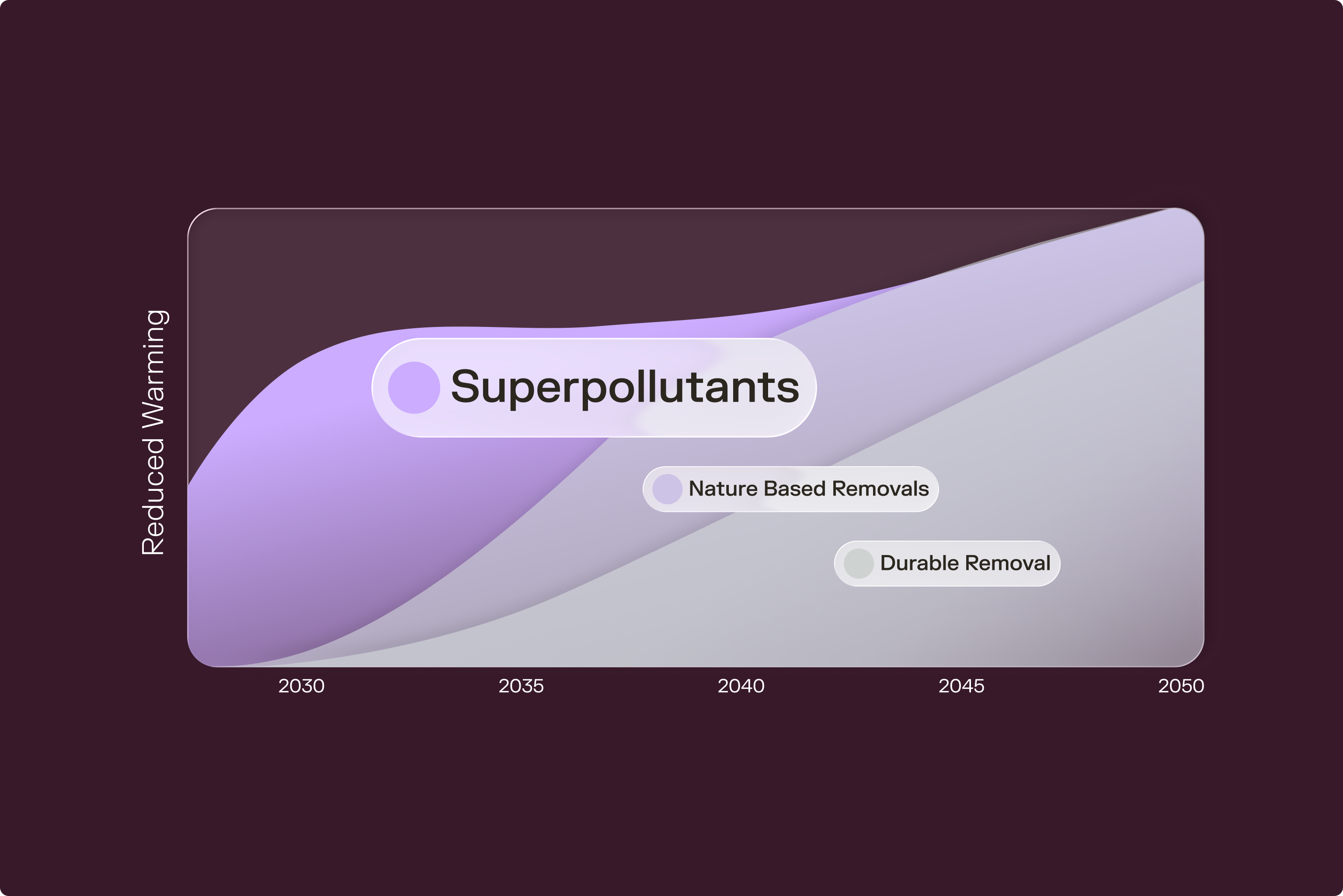
CUR8 has consistently argued that the choice between nature-based and engineered removals is a false one, an unhelpful relic from the early days of carbon removals
Melanie heartily agreed. Microsoft's portfolio spans low, medium, and high durability solutions across all removal types. The logic isn't environmental preference — it's risk management, the same principle behind any balanced financial portfolio. Nature-based removals have the highest technology readiness today, can be deployed now at lower cost, and there is a real time value of carbon. Engineered solutions carry more technology uncertainty but much less reversal risk. A well-constructed portfolio holds both, and CUR8 has built its approach to buyer portfolios around exactly this thinking.
Microsoft published every deal in their portfolio — the tonnage, duration, partner, methodology. Melanie compared it to an Olympic sprinter sharing their entire training programme so others can surpass them. This kind of transparency is what the market needs to grow.
The Finance Piece: You've Seen This Before
Melanie made the point that the financial structure underpinning the carbon removal market is not new. It is the same model that drove the clean energy transition.
Power purchase agreements took ten to fifteen years to become standard, but once they did, they unlocked the capital that brought solar and wind prices down dramatically. SAF certificates followed the same logic. Carbon removal offtake agreements are the next step — a forward commitment from a credible buyer that gives lenders the confidence to finance projects during the build phase. A bankable offtake agreement can be collateralised. It gets capital to projects early, reduces delivery risk, and doesn't require the buyer to pay everything upfront. When you take this to your CFO, you're not describing something untested. You're describing a structure they've seen work before.
CUR8 has been working directly with banks including Standard Chartered on exactly this — structuring offtake agreements that are bankable for both buyers and project developers, so that capital reaches projects early enough to matter.
You Don't Have to Start at 78 Million Tonnes
Microsoft didn't. They started small, built conviction, and grew. Melanie's challenge to the room: what is blocking your get-to-yes moment? Because the answer usually points to the right first step. If price is the barrier, start with nature-based removals where cost per tonne is lower. If it's technology confidence, work with partners like CUR8 who have already built the scientific diligence so you don't have to. If it's internal buy-in, join a buyer coalition, pool your demand with other organisations, and take your offtake from the pool alongside credible logos.
That's exactly what CUR8 is here for — to give companies the due diligence, the risk assessment, and the market access that Microsoft built over years, without having to build it themselves. The companies CUR8 is already talking to go well beyond the usual sustainability leaders — equipment manufacturers learning a market they want to sell into, banks understanding a market they want to lend into, professional services firms responding to client demand. None of them started at scale. All of them started somewhere.
Click here to talk to CUR8 about building your carbon removal strategy today
Read Microsoft's 2025 Carbon Removal Report
CUR8 co-hosted "Pilots to Portfolios: Deploying a Carbon Removal Playbook at Scale" with Microsoft at Goals House Davos on 22 January 2026. The session featured Dr. Gabrielle Walker (CUR8) and Melanie Nakagawa (Microsoft), with contributions from senior leaders from British Airways, Standard Chartered, and Deloitte.

March 25, 2026
.jpg)
.png)